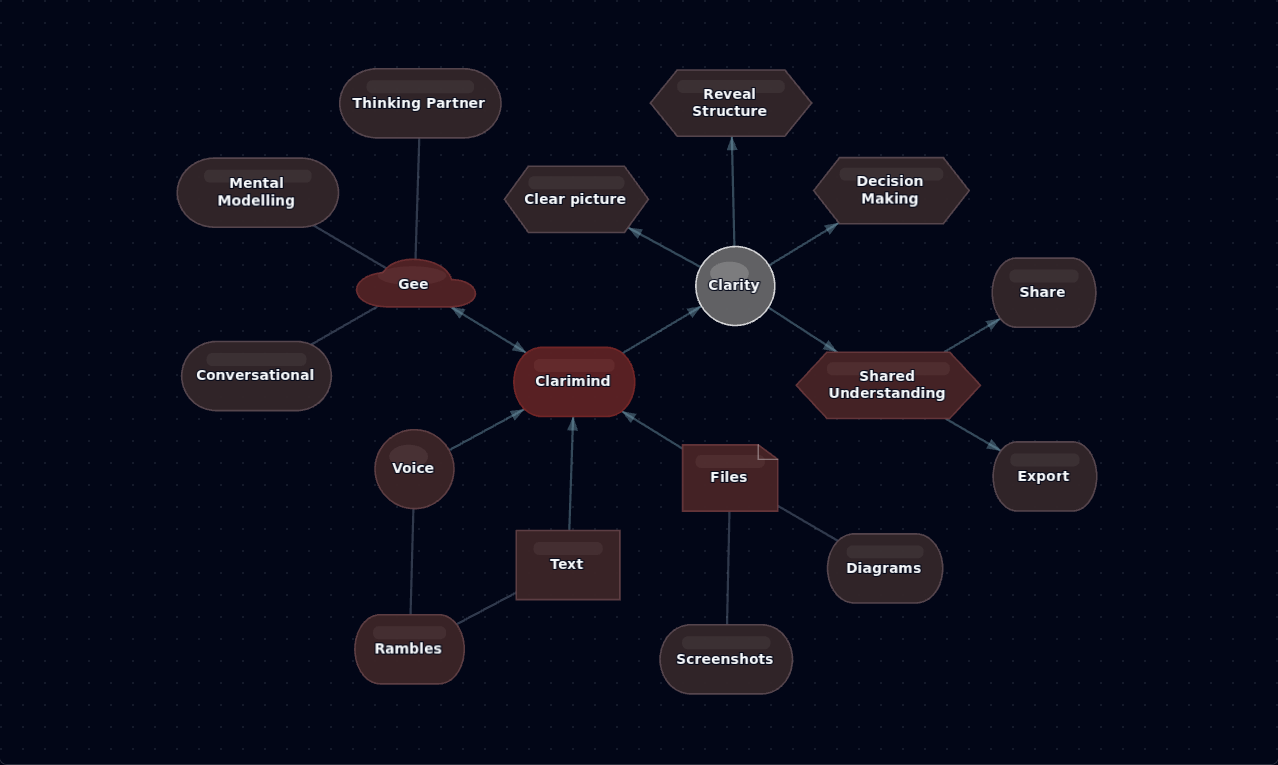
Interactive examples

See natural speech become a map you can work with.

These are real Clarimind canvas surfaces built from synthetic examples. Move the concepts, explore their relationships, and see how reflection, systems thinking, and team planning each form a different shape.

Drag nodes or the background. Scroll or pinch to zoom.

Reflection Thought patterns Recorded voice

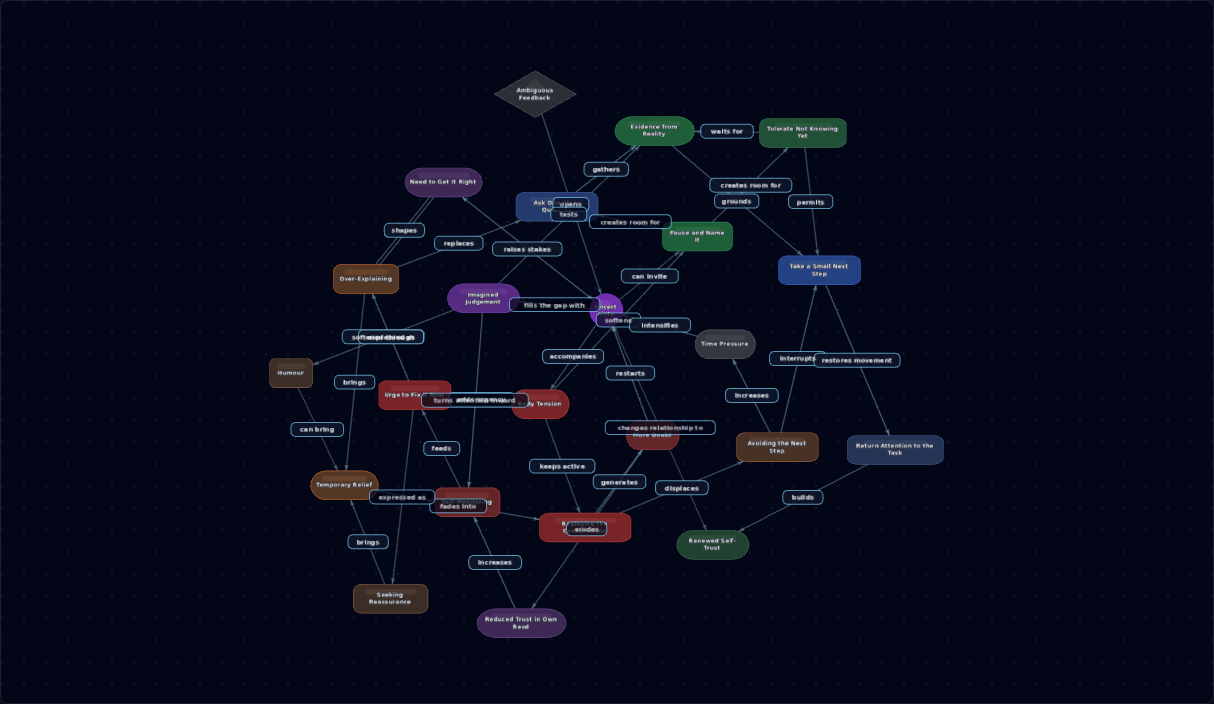
Breaking an Overthinking Loop

For an individual untangling a recurring thought pattern without treating the map as diagnosis or psychological fact.

Canvas Preview

Drag nodes or the background. Scroll or pinch to zoom.

  1. 1. Original input

    A person talks naturally about ambiguous feedback, the urge to fix it immediately, replaying the conversation, seeking reassurance, and finding it difficult to return attention to the next task.

  2. 2. What Gee notices

    Gee separates described events, thoughts, bodily responses, protective actions, consequences, and possible interruption points. Interpretations remain tentative and editable.

  3. 3. Structured result

    The finished map exposes two connected shapes: a self-reinforcing uncertainty loop and a practical route back through pausing, checking evidence, tolerating uncertainty, and taking one small step.

  4. 4. Human correction

    The person can move concepts, change relationship direction or strength, and remove any interpretation that does not match their experience.

  5. 5. Reopened and reused

    The saved structure can be revisited after another similar moment to compare what repeated, what changed, and which interruption was useful.

Systems thinking Service operations Architecture

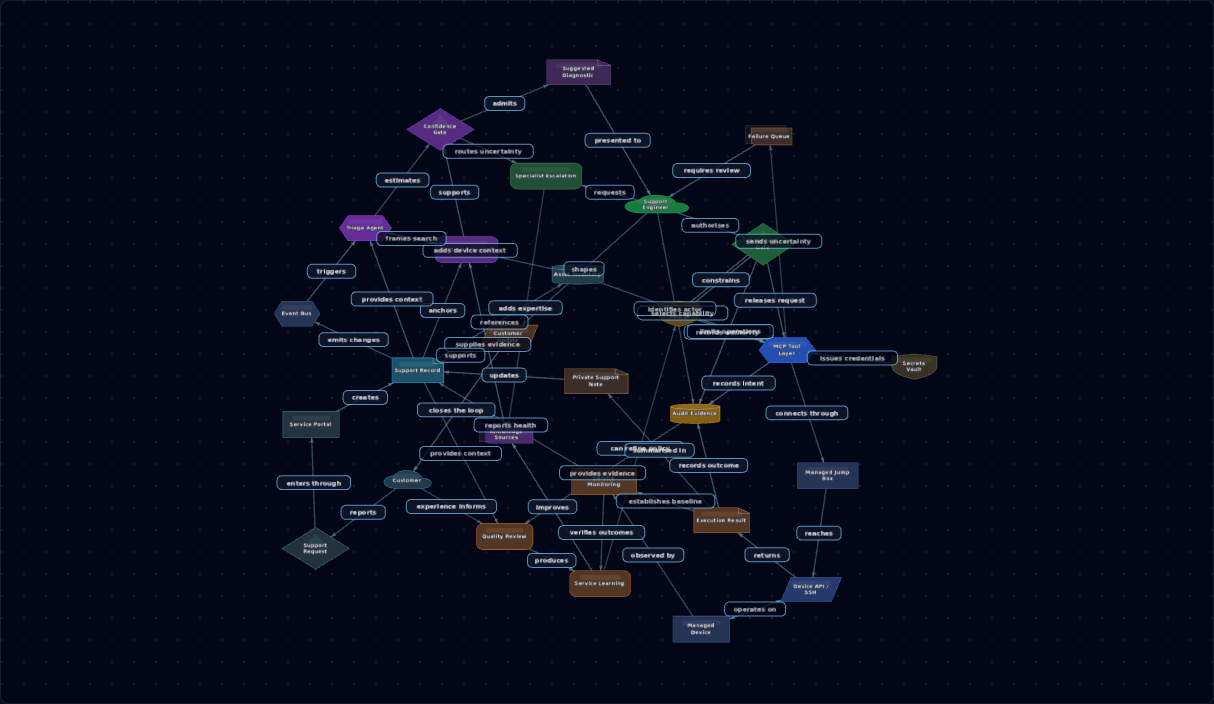
From Customer Signal to Safe Action

For technical and service teams making dependencies, authority boundaries, feedback routes, and operational risk visible.

Canvas Preview
Drag nodes or the background. Scroll or pinch to zoom.

  1. 1. Original input

    A technical lead explains how a customer request becomes a support record, gathers device and knowledge context, reaches an engineer, and may trigger a tightly controlled diagnostic action.

  2. 2. What Gee notices

    Gee identifies systems, actors, evidence, decisions, security controls, data stores, failure routes, and feedback loops rather than flattening the explanation into a single process list.

  3. 3. Structured result

    The map shows several centres of authority: customer context, triage, human approval, RBAC, tool execution, audit evidence, monitoring, quality review, and service learning.

  4. 4. Human correction

    An engineer can correct which system owns a decision, tighten a control relationship, or separate a recommendation from an authorised action.

  5. 5. Reopened and reused

    The canvas can support an architecture review, implementation plan, risk discussion, or later comparison against the system that was actually delivered.
Team planning Events Mobilisation

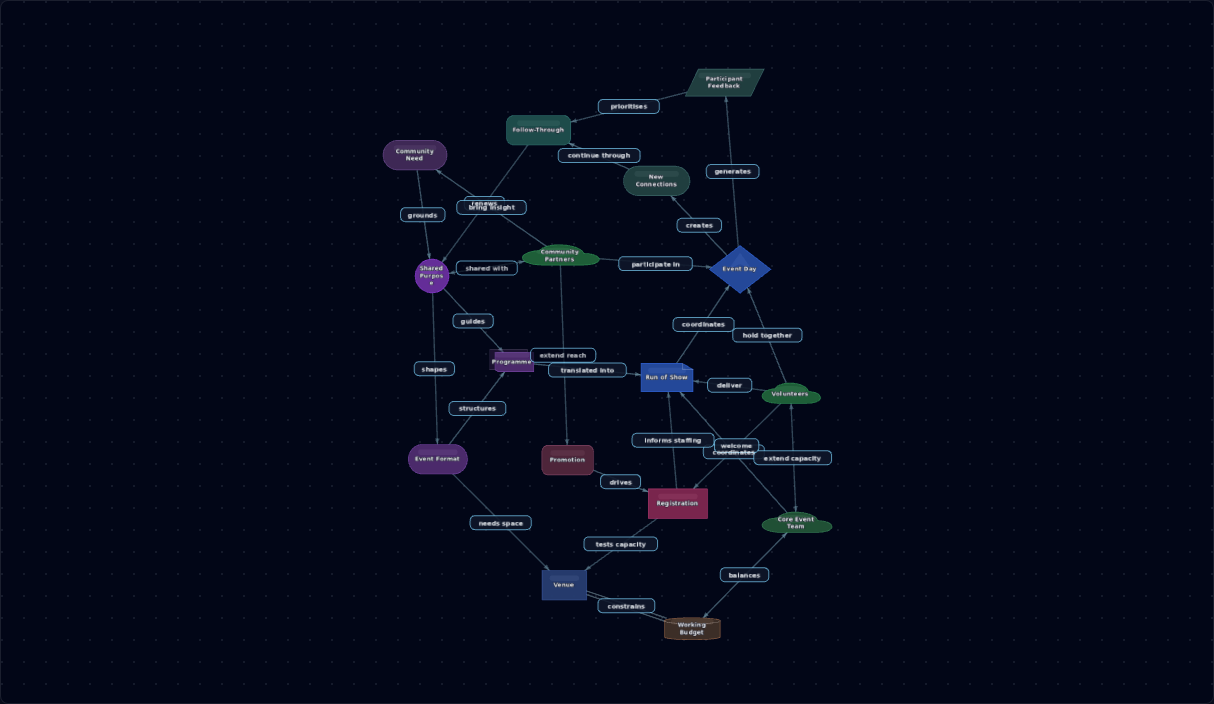
Mobilising a Community Ideas Festival

For teams coordinating an event or mobilisation where people, purpose, programme, logistics, outreach, and follow-through affect one another.

Canvas Preview

Drag nodes or the background. Scroll or pinch to zoom.

  1. 1. Original input

    A small organising team talks through why the event matters, who needs to be involved, what must happen on the day, and how budget, venue, volunteers, registration, promotion, and follow-through interact.

  2. 2. What Gee notices

    Gee preserves the discussion as a connected web, distinguishing shared purpose, people, resources, programme, operational documents, event-day activity, outcomes, and learning.

  3. 3. Structured result

    The map makes crossing dependencies visible without turning the conversation into an oversized flowchart: purpose shapes the programme, budget constrains the venue, registration informs staffing, and event outcomes feed future action.

  4. 4. Human correction

    The team can regroup concepts around the real owners, add a missing dependency, or change a relationship when the plan develops.

  5. 5. Reopened and reused

    The same canvas can anchor planning meetings before the event and become a record of feedback, new connections, and follow-through afterwards.